

Global Law Enforcement & Military Clothing Market Led by North America, Key Players Safariland, Propper, 5.11 Tactical
Law Enforcement and Military Clothing Market
Germany’s defense modernization, NATO mandates, and advanced textile innovation are reshaping procurement, accelerating premium gear adoption through 2036.
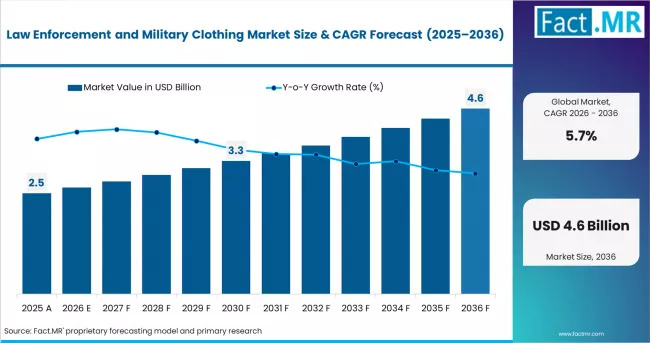
ROCKVILLE, MD, UNITED STATES, April 15, 2026 /EINPresswire.com/ -- According to the latest analysis by Fact.MR, the global law enforcement and military clothing market is undergoing a structural transformation, with Germany emerging as a critical European growth engine.Market size is estimated at USD 2.5 billion in 2026, up from USD 2.4 billion in 2025
The market is projected to reach USD 4.3 billion by 2036, expanding at a CAGR of 5.7%
The sector is set to create an incremental opportunity of USD 1.8 billion over the forecast period
Get detailed market forecasts, competitive benchmarking, and pricing trends:https://www.factmr.com/connectus/sample?flag=S&rep_id=14724
Growth is being driven by the shift from standard uniforms to high-performance, certified protective clothing, including flame-resistant fabrics, ballistic gear, and IR-signature reduction apparel. Germany’s Bundeswehr modernization and EU-led compliance frameworks are accelerating demand for premium, NATO-aligned textile solutions.
Quick Stats
Market Size (2026): USD 2.5 Billion
Market Size (2027): ~USD 2.6 Billion (estimated)
Forecast Value (2036): USD 4.3 Billion
CAGR (2026–2036): 5.7%
Incremental Opportunity: USD 1.8 Billion
Leading Segment: Outerwear (45% share)
Leading End Use: Military (60% share)
Leading Region: Asia Pacific (fastest growth), Europe (compliance-driven)
Key Players: Safariland, Point Blank Enterprises, Propper International, 5.11 Tactical, Seyntex, Blauer Manufacturing
Executive Insight for Decision Makers
Germany’s market evolution reflects a strategic pivot toward certified, high-performance defense textiles.
Strategic Shift: Procurement is moving from volume-driven uniforms to specification-driven gear
Action Required:
Invest in aramid fiber integration and ballistic protection capabilities
Align with NATO STANAG and EU certification frameworks
Establish localized production or partnerships within Europe
Risk of Inaction:
Suppliers lacking certification, testing infrastructure, or compliance readiness risk exclusion from high-value Bundeswehr and EU defense tenders.
Market Dynamics
Key Growth Drivers
Bundeswehr modernization programs increasing clothing system upgrades
NATO standardization mandates raising performance benchmarks
Rising demand for flame-resistant and ballistic clothing
Replacement cycles for aging uniforms across Europe
Key Restraints
Long and complex defense procurement cycles
Volatility in raw material prices (especially aramid fibers)
High certification and compliance costs
Emerging Trends
Integration of IR-signature reduction technologies
Growing adoption of modular and multi-functional uniforms
Expansion of smart textiles and wearable defense systems
Sustainability compliance in EU textile manufacturing
Segment Analysis
Leading Segment:
Outerwear dominates with 45% market share in 2026
Driven by recurring replacement demand and large procurement volumes
Fastest-Growing Segment:
Protective gear (body armor & flame-resistant apparel) due to rising battlefield safety standards
Material Insight:
Aramid fibers lead, widely used in ballistic and fire-resistant applications
End Use:
Military accounts for 60% share, supported by multi-year procurement contracts
Strategic Importance:
High-specification segments command 30–50% price premiums, making them critical for margin expansion.
Supply Chain Analysis (Critical Insight)
Value Chain Structure
Raw Material Suppliers:
Aramid fiber producers, technical textile manufacturers
Manufacturers / Producers:
Companies producing uniforms, armor systems, and tactical gear
Distributors:
Defense contractors, government-approved procurement agencies
End-Users:
Military forces (Bundeswehr), police units, border security agencies
Who Supplies Whom
Aramid suppliers → Textile manufacturers → Certified gear producers
Producers → Government procurement bodies (e.g., defense ministries)
Procurement agencies → Military and law enforcement units
Germany’s supply chain is highly regulated, with centralized procurement ensuring only certified suppliers participate in tenders.
Pricing Trends
Commodity vs Premium:
Standard uniforms operate on low-margin, volume-based pricing
Advanced protective gear commands 30–50% premium pricing
Key Influencing Factors:
Raw material costs (aramid, FR fabrics)
Certification and testing requirements
Customization and performance specifications
Margin Insights:
Higher margins concentrated in certified, high-performance segments
Non-certified players remain in low-value supply tiers
Regional Analysis
Top 5 Countries by CAGR (2026–2036)
India: 7.7% – Driven by localization and defense expansion
China: 7.3% – Supported by state-led military modernization
United States: 6.0% – Strong defense and law enforcement funding
United Kingdom: 5.8% – Counterterrorism and tactical upgrades
Germany: 5.5% – Compliance-driven growth under EU and NATO frameworks
Germany Insights
Centralized procurement via defense agencies
Strong emphasis on environmental and safety certifications
Growth driven by Bundeswehr upgrades and EU defense funding
Developed vs Emerging Markets
Developed markets (Germany, U.S.): High compliance, slower cycles, premium pricing
Emerging markets (India, China): Faster growth, localization-driven demand
Competitive Landscape
Market Structure: Semi-consolidated, certification-driven
Top Players:
Safariland
Point Blank Enterprises
Propper International
5.11 Tactical
Seyntex
Blauer Manufacturing
Competitive Strategies
Investment in ballistic and flame-resistant technologies
Expansion of certification capabilities
Strategic defense contracts and long-term agreements
Product innovation in modular and tactical gear
Strategic Takeaways
For Manufacturers
Focus on certified, high-performance product lines
Build compliance infrastructure aligned with NATO standards
For Investors
Target companies with defense contracts and certification advantages
High ROI potential in premium protective gear segments
For Marketers / Distributors
Position offerings around performance, compliance, and durability
Strengthen relationships with government procurement bodies
Future Outlook
The market is set to evolve toward technology-integrated, sustainability-compliant defense textiles.
Increasing adoption of smart fabrics and wearable systems
Sustainability becoming a key procurement criterion in Europe
Long-term opportunity lies in high-specification, mission-critical gear
Germany will remain a strategic hub in Europe, driven by regulatory rigor and defense modernization.
Conclusion
The law enforcement and military clothing market is transitioning from volume-driven supply to performance-led procurement. Germany’s compliance-first ecosystem and NATO alignment position it as a high-value growth center within Europe.
For decision-makers, the opportunity lies in certification, innovation, and strategic alignment with defense procurement systems the defining factors for success in this evolving market.
Why This Market Matters
This market underpins national security, personnel safety, and defense readiness. As geopolitical tensions rise and modernization accelerates, demand for advanced, certified protective clothing will continue to expand making it a mission-critical investment space for the next decade.
Unlock 360° insights for strategic decision making and investment planning: https://www.factmr.com/checkout/14724
To View Our Related Report:
Lawn Sprinkler Market: https://www.factmr.com/report/1010/lawn-sprinkler-market
Smart Clothing Market: https://www.factmr.com/report/196/smart-clothing-market
Steam Clothing Care System Market: https://www.factmr.com/report/1821/steam-clothing-care-system-market
Cosplay Clothing Market: https://www.factmr.com/report/cosplay-clothing-market
S. N. Jha
Fact.MR
+1 628-251-1583
email us here
Legal Disclaimer:
EIN Presswire provides this news content "as is" without warranty of any kind. We do not accept any responsibility or liability for the accuracy, content, images, videos, licenses, completeness, legality, or reliability of the information contained in this article. If you have any complaints or copyright issues related to this article, kindly contact the author above.
